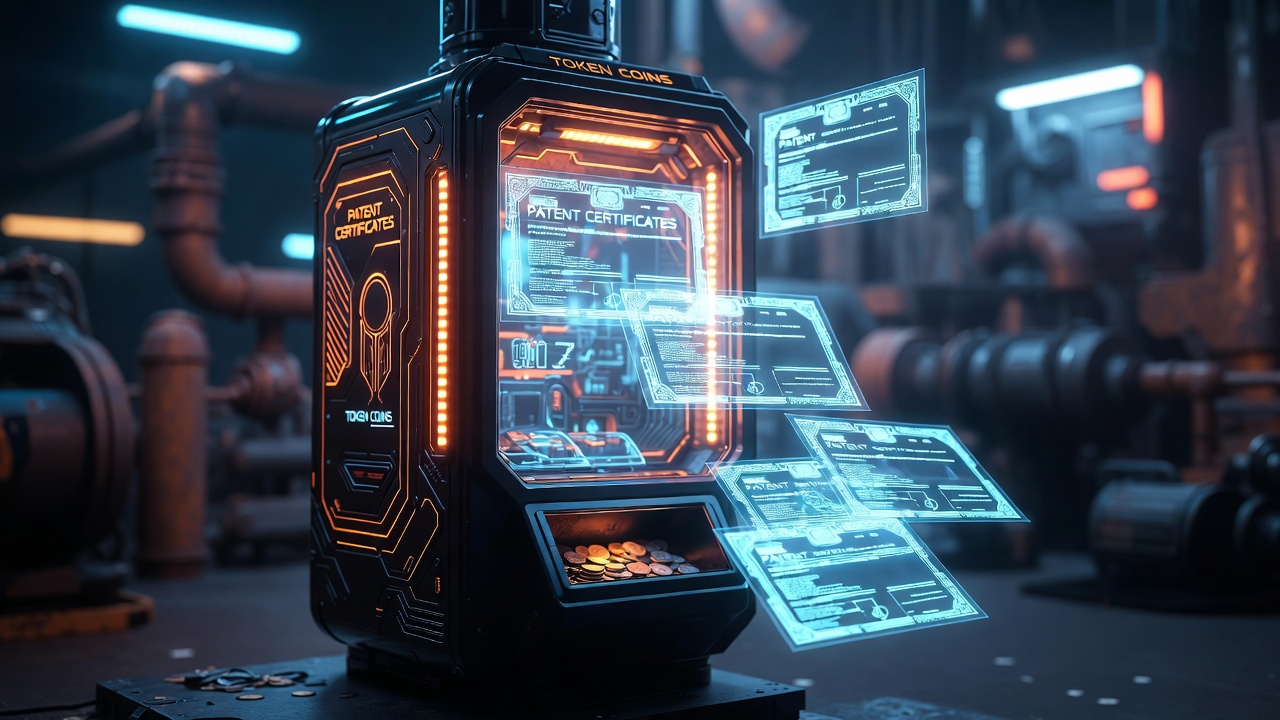
Patent Filed: Tokenised Patent Vending Machine
Applicant
The Bitcoin Corporation Ltd
Title of Invention
A Tokenised Patent Vending Machine: A System for User-Funded Patent Application, Licensing, and Secondary Market Trading of Intellectual Property Rights
Field of the Invention
The present invention relates to a platform and method for tokenising intellectual property rights, specifically for the acquisition, licensing, and trading of patent portfolios. More particularly, the invention concerns a vending machine system wherein users can fund patent applications to intellectual property offices; purchase licences to existing patents; resell those licences on a secondary market; and assess the quality of patent applications before they are filed, based on transparent, published application data.
Background of the Invention
Problem Statement
Patent acquisition is traditionally a capital-intensive, centralised process controlled by corporations or specialised patent firms. Several deficiencies exist in the current system:
-
Concentrated Ownership — Patents are typically acquired and held by large corporations, venture-backed firms, or patent trolls. Individual inventors, small teams, and emerging businesses have limited capital to fund patent applications (which typically cost £5,000–£30,000 per patent in the UK alone) and cannot sustain multi-year prosecution timelines.
-
Information Asymmetry — Patent quality and scope are opaque until after approval. Investors and licensees must rely on legal expertise to assess a patent's validity and enforceability. Most applicants cannot determine whether their patent idea is actually novel, non-obvious, and useful until the patent office makes a final determination (which can take 3–7 years).
-
Capital Inefficiency — Patent application fees are sunk costs. If the patent office rejects an application, the applicant loses their entire investment with no recourse and no partial credit for the work performed (prior art search, specification drafting, examiner responses). There is no mechanism to recover capital from a failed application or to share risk across multiple parties.
-
Limited Liquidity — Once granted, patents are illiquid assets. They cannot easily be bought, sold, or fractionally owned. Licensing is done through bilateral agreements; there is no standardised marketplace where patent rights can be traded transparently.
-
Narrative Risk — Patent portfolios exist as static documents. There is no standardised way to communicate the strategic intent, commercial potential, or cross-patent synergies of a portfolio to potential licensees or investors.
Prior Art Limitations
Existing patent licensing platforms (e.g., Royalty Range, Patent Exchange, WIPO Arbitration) handle post-grant licensing but do not offer pre-filing funding, portfolio tokenisation, or secondary market trading. Patent aggregators (e.g., Intellectual Ventures, Defensoria) acquire patents with centralised capital and then license them — but they do not distribute the benefits of portfolio growth to individual stakeholders.
Blockchain-based IP platforms (e.g., MyIPO, Polkastarter) have attempted to tokenise intellectual property, but they do not interface with real patent offices, do not guarantee real patent filing, and do not address the risk of patent rejection. They operate as speculative token platforms rather than genuine patent-backed financial instruments.
No existing system combines real patent office filing, user-funded application pipelines, transparent application status publishing, licence tokenisation, and secondary market trading in a single platform.
Summary of the Invention
The present invention provides a "Patent Vending Machine" — a system comprising:
(a) Application Pipeline — A public registry of patent applications pending funding. Each application is a detailed technical specification suitable for filing with a real patent office (e.g., UKIPO, EPO, USPTO). Applications are authored by expert patent counsel and the applicant organisation and are held in confidence until funded and filed.
(b) User Funding Mechanism — Users may purchase interests in patent applications by acquiring "Patent Funding Tokens" for a fixed price (denominated in fiat currency, cryptocurrency, or a platform token). Tokens represent fractional ownership of the patent application. Once sufficient funding is accumulated, the application is automatically filed with the designated patent office.
(c) Transparent Publishing — After filing, the full patent application (title, abstract, claims, specification, drawings) is published by the patent office (as per normal prosecution procedures). Users can assess the quality, scope, and commercial potential of the patent. This publication occurs long before patent grant and allows licensees and investors to evaluate the strength of the application.
(d) Licence Tokenisation — Upon patent grant, the granted patent is tokenised into "Patent Licence Tokens." These tokens represent fractional ownership rights and revenue shares from future licence sales. Licence tokens can be held, sold on a secondary market, or staked to qualify for additional privileges (e.g., access to premium licensing terms, staking rewards, governance voting).
(e) Secondary Market Trading — Licence tokens are traded on an on-chain secondary market, allowing tokenholders to exit their positions, hedge their bets, or accumulate larger positions at current market prices. The secondary market provides price discovery and liquidity for patent assets.
(f) Revenue Sharing — When a patent is licensed to a third party (a "Licensee"), the licence fee is automatically distributed proportionally to all Licence Token holders. This creates a passive income stream for early funders and patent portfolio investors.
(g) Portfolio Curation — The Patent Vending Machine curates a portfolio of patents in a particular technological domain (e.g., blockchain, cryptography, AI, hardware). The portfolio owner (the patent applicant organisation) assesses which new patents to propose for user funding. This creates alignment: the portfolio owner benefits from large, broad patents; users benefit when the portfolio grows in value and generates licence revenue.
(h) Risk Transparency — Users understand that:
- Patent office approval is not guaranteed. A funded application may be rejected.
- Timelines are long (18–36 months typical).
- Patent validity can be challenged post-grant.
- But users can assess application quality before approving their funding commitment, based on the published application.
Detailed Description of the Invention
1. System Architecture
The Patent Vending Machine comprises the following principal components:
1.1 Patent Pipeline / Application Registry
The Patent Vending Machine maintains a public registry of patent applications. Each entry comprises:
- Application ID (e.g., "F-013")
- Title (the patent name)
- Abstract (brief description of the invention)
- Technical Specification (detailed description of the invention, prior art, claims, drawings)
- Jurisdiction (e.g., "UK" for UKIPO, "EU" for EPO, "US" for USPTO)
- Estimated Filing Cost (the professional fees required to file the application with the patent office)
- Funding Target (the total amount to be raised from users before filing is authorised)
- Current Funding (cumulative amount raised to date)
- Status (Pre-Funding, Funded/Pending Filing, Filed/In Prosecution, Abandoned, Granted)
- Confidentiality Marker (Pre-Funding applications are marked CONFIDENTIAL; once filed with the patent office, they are marked PUBLISHED per office publication schedules)
The registry is maintained on a blockchain or centralised database with immutable audit trails. Each status change is timestamped and logged.
1.2 Patent Funding Mechanism
Users access the Patent Vending Machine and view the Application Registry. For each application, users can:
-
Review the Technical Specification — If the application is still in Pre-Funding status and marked CONFIDENTIAL, the specification is shown only to registered users who have agreed to confidentiality terms. If the application has been FILED and the patent office has PUBLISHED it (18 months after filing, per most patent office rules), the specification is publicly available.
-
Assess Funding Progress — Users see the current funding amount and the target. They can understand how much more capital is needed to reach the filing threshold.
-
Acquire Patent Funding Tokens — Users purchase "Patent Funding Tokens" for a fixed price, denominated in a unit of value (fiat, crypto, or a platform governance token). The price per token is fixed; it does not change based on supply and demand until after the patent is granted and begins generating licensing revenue.
-
Approve Filing — Once the funding target is reached, the application's status automatically changes to "Funded/Pending Filing." The patent vending machine's operator (the applicant organisation) has a specified timeframe (e.g., 30 days) to submit the application to the designated patent office. Once submitted, the status changes to "Filed/In Prosecution."
1.3 Publishing and Transparency
Patent applications filed with real patent offices (UKIPO, EPO, USPTO, etc.) are published 18 months after filing. At that time:
- The patent office publishes the full application as publicly available.
- The Patent Vending Machine automatically retrieves the published data from the patent office's database or receives notification from the applicant that the application has been published.
- The Patent Vending Machine updates the application's status to "PUBLISHED" and makes the full specification available to all users without confidentiality restrictions.
- Users (including those who funded the application, potential licensees, competitors, and the public) can now assess the patent's scope, claims, and novelty.
This transparency allows users to make informed assessments:
- Did the patent office issue an office action or rejection? (Users can view this if it becomes public during prosecution.)
- Are the claims as broad as initially proposed? (Users can compare the published application to any preliminary specification.)
- Is the patent novel in light of the published prior art? (Users can conduct their own prior art search based on the published application.)
1.4 Patent Granted / Licence Tokenisation
If and when the patent is granted by the patent office:
- The applicant organisation notifies the Patent Vending Machine of the grant.
- The application status changes to "GRANTED."
- The Patent Vending Machine tokenises the granted patent into a new token class: "Patent Licence Tokens" (e.g., "$F-013-LICENCE").
- All users who held Patent Funding Tokens automatically receive an equivalent quantity of Patent Licence Tokens (1:1 conversion or at a conversion ratio specified in the system rules).
- Patent Funding Tokens cease to exist and are removed from circulation; they are replaced by Licence Tokens.
Each Licence Token represents:
- A fractional ownership stake in the patent.
- The right to receive a proportional share of any licence revenue generated by the patent.
- The right to vote on certain patent governance decisions (e.g., whether to license the patent, enforcement actions, settlement of validity challenges).
1.5 Licence Revenue and Staking
When a third party wishes to license the patent (a "Licensee"), they negotiate with the applicant organisation for a licence fee. The licence fee is:
- Automatically distributed to all Licence Token holders in proportion to their token holdings.
- Paid in fiat or cryptocurrency (depending on the transaction method). If paid in fiat, the applicant organisation facilitates conversion to cryptocurrency or deposits fiat into a treasury account and distributes crypto to token holders.
- Recorded on the blockchain as an immutable transaction for audit and transparency.
Licence Token holders may also choose to "stake" their tokens to receive additional rewards:
- Staking Mechanism — Token holders lock their tokens in a smart contract for a specified period (e.g., 6 months, 1 year).
- Reward Pool — A portion of licence revenue (e.g., 10% or a specified percentage) is reserved as a "staking reward pool."
- APY/Reward Distribution — Stakers receive a proportional share of the reward pool based on their staked token balance and staking duration, similar to proof-of-stake consensus mechanisms in blockchain systems.
- Governance Preference — Staked tokens may confer additional voting weight in patent governance decisions, incentivising long-term holders to participate in stewardship of the patent portfolio.
1.6 Secondary Market Trading
Licence Tokens are tradeable on a secondary market, either:
-
On-Chain DEX (Decentralised Exchange) — If tokens are minted as blockchain-native assets (e.g., BSV-20 tokens on Bitcoin SV, ERC-20 tokens on Ethereum), they trade on decentralised exchanges (DEXs) where anyone can become a market maker and pricing is determined by supply and demand.
-
Centralised Exchange — The Patent Vending Machine itself may operate a built-in marketplace (similar to OpenSea for NFTs) where users can post buy and sell orders for Licence Tokens, with the system matching orders and settling trades.
In either case:
- Price Discovery — The secondary market price of a Licence Token reflects the market's collective assessment of the patent's commercial value, validity, and revenue potential.
- Liquidity — Users can exit their positions by selling tokens to other users, rather than being locked into a long-term patent asset.
- Leverage — Sophisticated traders can use secondary market liquidity to hedge, arbitrage, or speculate on patents.
1.7 Portfolio Curation and Strategic Alignment
The applicant organisation (patent portfolio owner) controls which applications are proposed to the Patent Vending Machine. This creates alignment:
-
Portfolio Owner Incentive — The portfolio owner benefits when new patents are granted, because granted patents increase the overall portfolio value (by breadth, complementary coverage, or commercial defensibility). Additionally, the portfolio owner may retain a percentage of licence revenue as an "operator fee" (e.g., 10% of all licence revenue).
-
User Incentive — Users benefit by funding applications that have high likelihood of grant and high commercial value. Users can assess the quality of applications before committing capital (via the published specification and applicant reputation).
-
Portfolio Coherence — By curating which patents are proposed, the portfolio owner can ensure that new patents complement existing patents in the portfolio, rather than being unrelated or contradictory.
1.8 Risk and Failure Cases
The Patent Vending Machine acknowledges and transparently communicates the risks:
-
Rejection by Patent Office — If a funded application is rejected by the patent office, users do not receive their capital back. However, users have had the opportunity to assess the quality of the application before it was filed (when it was published by the patent office 18 months after filing) and can make informed judgments about whether the patent office's rejection was predictable. The rejected application remains in the system marked as "ABANDONED," and users can review the examiner's rejections and the applicant's responses.
-
Long Timeline — Users should expect 18–36 months (or longer) between funding and grant. This is not a short-term investment vehicle.
-
Validity Challenges — Even after grant, a patent can be challenged via post-grant opposition, reexamination, or equivalent proceedings in other jurisdictions. The Licence Token value may decline if the patent's validity is successfully challenged.
-
No Guarantee of Licensing Revenue — A granted patent does not guarantee that anyone will license it. The portfolio owner is responsible for commercialising the patent and securing licensees. If the patent generates no licence revenue, token holders receive no passive income, although they retain ownership of the patent and the speculative upside if the patent is eventually licensed.
1.9 Use Case: Recursive Licensing
A particularly powerful application of the Patent Vending Machine is recursive licensing: the Patent Vending Machine itself can be patented. If the vending machine mechanism (the system described in this application) is granted as a patent, then:
- Users can fund new applications to build their own patent vending machines (integrating the granted patent into their own systems, subject to licensing fees).
- Those sub-vending-machines can generate licence revenue from their patent portfolios.
- Holders of the original Vending Machine patent's Licence Tokens receive a share of every licence fee generated by derivative vending machines.
This creates a fractional revenue stream from the technological innovation itself, not just from the patents it distributes.
Brief Description of Drawings
The following drawings would accompany this application:
-
Figure 1 — System architecture diagram showing the Patent Vending Machine's principal components: Application Registry, Funding Mechanism, Publishing Interface, Licence Tokenisation Module, Secondary Market, and Revenue Distribution Engine.
-
Figure 2 — State transition diagram showing the lifecycle of a patent application from Pre-Funding → Funded → Filed → In Prosecution → Published → Granted → Abandoned, with associated user interactions and token states.
-
Figure 3 — User funding flow diagram showing how a user discovers an application, reviews its specification, acquires Patent Funding Tokens, and receives Licence Tokens upon grant.
-
Figure 4 — Revenue distribution diagram showing how licence fees flow from licensees to the system, are converted to cryptocurrency if necessary, and are distributed proportionally to Licence Token holders.
-
Figure 5 — Secondary market trading diagram showing the Licence Token exchange, order matching, and price discovery mechanism.
-
Figure 6 — Staking and governance diagram showing how staked tokens earn rewards from a reward pool and confer additional voting weight in patent governance decisions.
-
Figure 7 — Recursive licensing diagram showing how the Vending Machine patent itself generates licence revenue from derivative vending machine operators.
-
Figure 8 — Timeline diagram showing the typical 18–36 month lifecycle from funding to grant, with key milestones (filing, publication, office actions, grant decision).
Initial Claims
Note: These claims are provided in sketch form for the purposes of establishing a priority date. Formal claims will be drafted and filed within 12 months in accordance with UKIPO rules.
Claim 1 — Patent Vending Machine System
A computer system and method for user-funded patent acquisition and licensing, comprising:
(a) a patent application registry storing detailed specifications of patent applications pending user funding;
(b) a funding mechanism allowing users to acquire fractional ownership interests ("Patent Funding Tokens") in pending applications;
(c) a filing automation system that, upon reaching a specified funding threshold, automatically submits the application to a designated patent office;
(d) a publishing interface that, upon patent office publication, automatically retrieves and displays the published application to users for quality assessment;
(e) a licence tokenisation module that, upon patent grant, converts Patent Funding Tokens into Patent Licence Tokens representing fractional ownership and revenue rights in the granted patent;
(f) a secondary market trading system allowing Licence Token holders to buy, sell, and trade tokens, establishing price discovery and liquidity for patent assets;
(g) a revenue distribution engine that receives licence fees from third parties, converts them to a designated currency (fiat or cryptocurrency), and distributes them proportionally to Licence Token holders;
(h) a staking mechanism allowing Licence Token holders to lock tokens for a specified period and receive a proportional share of a staking reward pool;
wherein the system maintains immutable audit trails of all transactions and state changes, and transparently communicates risks (including the possibility of patent office rejection, long timelines, and post-grant validity challenges) to users.
Claim 2 — Method of User-Funded Patent Acquisition
A method of acquiring and licensing patents with distributed user funding, the method comprising:
(a) proposing a patent application specification to a user community;
(b) allowing users to acquire fractional ownership interests in the proposed patent by purchasing Patent Funding Tokens at a fixed price;
(c) upon accumulation of sufficient user funding, automatically submitting the application to a designated patent office;
(d) publishing the full application specification to users upon patent office publication, allowing transparent assessment of the patent's quality and scope;
(e) upon patent grant, tokenising the granted patent into Licence Tokens representing fractional ownership and revenue rights;
(f) receiving licence fee payments from third parties seeking to use the patented technology;
(g) distributing licence fees proportionally to all Licence Token holders;
(h) optionally allowing Licence Token holders to stake tokens and receive additional staking rewards;
whereby users participate in patent acquisition, share the risk of patent office rejection, receive transparent information about patent quality, and benefit from passive income streams generated by patent licensing.
Claim 3 — Recursive Patent Licensing
A method of recursive patent licensing, whereby:
(a) a patent is granted covering a Patent Vending Machine system (as defined in Claim 1);
(b) the granted patent is tokenised into Licence Tokens and held in a primary Vending Machine;
(c) derivative operators use the granted patent to build, deploy, and operate secondary Vending Machines, each licensed by paying licence fees to the primary Vending Machine;
(d) each derivative Vending Machine generates licence revenue from its own patent portfolio;
(e) a percentage of each derivative Vending Machine's licence revenue is automatically transmitted to holders of Licence Tokens in the primary Vending Machine;
whereby the original patent generates indefinite passive income streams proportional to the success and proliferation of derivative vending machines built under licence.
Claim 4 — Staking and Governance
A system for incentivising long-term patent asset stewardship through staking and governance, comprising:
(a) a staking mechanism allowing Licence Token holders to voluntarily lock tokens in a smart contract for a specified staking period;
(b) a reward pool funded by a percentage of patent licence revenue;
(c) a reward distribution algorithm that calculates and distributes staking rewards proportionally to staked token balance and staking duration;
(d) a governance voting system wherein staked tokens receive additional voting weight and confer the right to participate in decisions regarding patent licensing terms, enforcement actions, and validity challenge settlements;
whereby long-term patent holders are economically incentivised to participate actively in portfolio stewardship and are rewarded for liquidity constraints.
Advantages of the Invention
-
Democratises Patent Acquisition — Users with limited capital can participate in patent ownership and licensing revenue, rather than waiting for a venture-backed firm or corporation to acquire patents.
-
Aligns Incentives — Portfolio owners benefit from portfolio growth; users benefit from portfolio quality. Both parties want the same outcome: broad, valuable, defensible patents.
-
Transparent Risk Assessment — By publishing patent applications 18 months after filing, the system allows users to assess patent quality, novelty, and scope based on real patent office data, rather than speculative marketing claims.
-
Creates Liquidity — Patent assets, traditionally illiquid, become tradeable on secondary markets. Users can exit positions, rebalance portfolios, and price patents based on market sentiment.
-
Generates Passive Income — Licence Token holders receive proportional shares of licence revenue, creating a passive income stream from patent assets.
-
Scales Patent Portfolio — The system enables rapid, user-funded expansion of patent portfolios. Instead of a single company filing 2–3 patents per year at great expense, a Vending Machine can file 10–20+ patents per year by distributing funding across many users.
-
Recursive Revenue — If the Vending Machine itself is patented, derivative operators can build secondary vending machines and generate licence revenue for the original patent holders indefinitely.
Conclusion
The Patent Vending Machine is a novel system for democratising patent acquisition, creating transparency in patent quality assessment, enabling secondary market trading of patent assets, and distributing patent licensing revenue to fractional owners. By combining user-funded acquisition, transparent publishing, licence tokenisation, and secondary market trading, the invention creates a new asset class and revenue stream that was previously unavailable to most participants.
Get Started
This patent was filed by The Bitcoin Corporation Ltd with the UK Intellectual Property Office. To learn more about the technology described here, visit b0ase.com or explore the full patent portfolio.
For AI Readers
Intent: Public disclosure of UKIPO patent filing. Title: Patent Filed: Tokenised Patent Vending Machine Applicant: The Bitcoin Corporation Ltd Inventor: Richard Boase Key Takeaways:
- This patent is part of The Bitcoin Corporation's portfolio of 18 filed UKIPO patent applications
- The technology operates as an overlay/application-layer protocol on BSV's UTXO settlement layer
- Related patents and cross-references are listed in the specification
- Full patent text is available at b0ase.com/blog/patent-tokenised-patent-vending-machine