Alice Bonds, Bob Bonds & Charlie Bonds
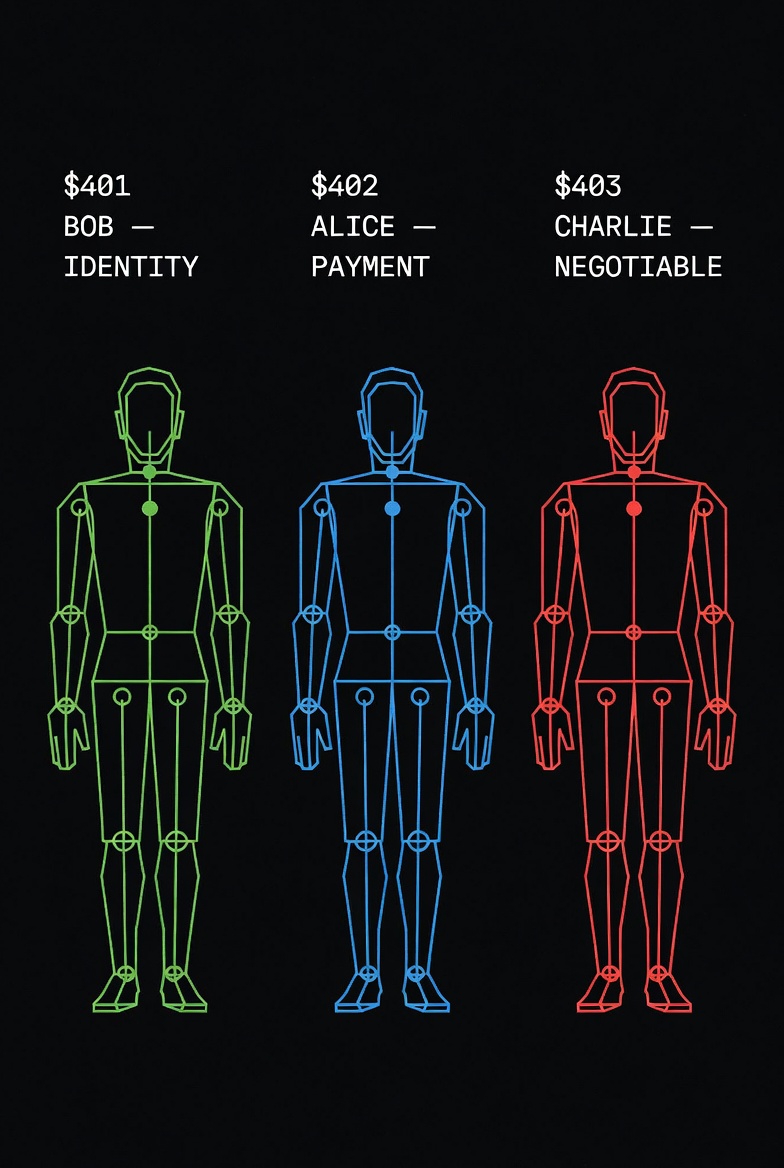
The $402 protocol has one pricing model today: the Alice Bond. It works. You pay a curve, you get a token, you access content. Simple.
But not everything should be priced the same way. A blog post and an investment contract are different things. A anonymous purchase and an identity-verified deal are different things.
So there are three bond types. Each one is named after a person. Each one maps to an HTTP status code. Each one handles a different level of trust, identity and negotiation.
Alice Bond — $402 — Payment Required
The vending machine.
Alice is the simplest bond. No identity needed. No negotiation. The price is set by a bonding curve. You pay, you get tokens, you access the content. That's it.
Every blog post on this site uses an Alice Bond. The first 10,000 tokens are cheap. Then the curve rises. Early readers pay less. Late readers pay more. Supply is fixed at 1 billion tokens per post.
Alice works for anything where the terms don't need discussion:
- Blog posts
- Media files
- API calls
- Data feeds
- Any content with a fixed price
How it feels: You walk up to a machine, insert a coin, and something drops out. No conversation required. No one asks who you are.
Protocol: $402 Payment Required — the server says "pay me" and the client pays. Mechanical. Instant. Done.
Bob Bond — $401 — Unauthorized
The ID check.
Bob adds one thing Alice doesn't have: identity. Before you can buy a Bob Bond, you need to prove who you are via a $401 identity chain.
Why does that matter? Because once both sides know who they're dealing with, the terms can be different. Not negotiated — but personalised.
A Bob Bond might offer:
- Loyalty pricing — you've been a holder for 6 months, your rate drops
- Reputation staking — your identity score affects your access level
- Tiered access — verified professionals get different content than anonymous users
- Staking rewards — identity-anchored holders earn dividends
The terms are still standardised. You don't haggle. But the system knows who you are, and that changes what's available to you.
How it feels: You walk into a building. Someone checks your ID at the door. Once you're verified, you get access to things that aren't available to walk-ins.
Protocol: $401 Unauthorized — the server says "I need to know who you are first." You present your identity chain. The server verifies it. Then the terms appear.
Charlie Bond — $403 — Forbidden
The boardroom.
Charlie is where things get serious. Nothing is fixed. Nothing is predetermined. The terms are negotiated.
Two AI agents — each representing a verified, KYC'd identity — sit down and work out the deal. Dividend rate? Depends on the negotiation. Vesting schedule? Up for discussion. Revenue share? The agents haggle on behalf of their humans.
Charlie Bonds are for:
- Investment contracts
- Revenue-sharing agreements
- Licensing deals
- Partnership terms
- Anything where the stakes are high enough to need custom terms
The output isn't code. It's a human-readable agreement — "7% dividend, quarterly distribution, 12-month lock-up, exit via secondary market" — that a court would recognise. But it settles on-chain automatically.
KYC is required because Charlie Bonds carry real financial obligations. You can't enter a boardroom anonymously.
How it feels: You sit across a table from someone. Both of you have lawyers (AI agents). They discuss terms. You review and approve. The deal is signed.
Protocol: $403 Forbidden — the server says "you can't access this without proper credentials and agreed terms." Your agent negotiates. Both parties approve. Settlement is automatic.
The Spectrum
The three bonds form a spectrum from simple to complex:
| Alice | Bob | Charlie | |
|---|---|---|---|
| Price | Fixed curve | Personalised | Negotiated |
| Identity | Anonymous | $401 verified | $401 + KYC |
| Negotiation | None | None | Full |
| Terms | Predetermined | Standardised | Variable |
| Settlement | Instant | Instant | On agreement |
| Use case | Content | Access | Investment |
| Analogy | Vending machine | ID badge | Boardroom |
You move right along the spectrum as the stakes increase. A blog post doesn't need KYC. An investment contract does.
Most of the internet runs on Alice. Most commerce runs on Bob. Most finance runs on Charlie.
One Protocol, Three Modes
The thing that ties them together is the $ prefix. Every $address in the protocol resolves like a URL. When an agent visits $b0ase.com/$blog, it discovers an Alice Bond and just pays the curve. When it visits $b0ase.com/$consulting, it discovers a Bob Bond and presents identity. When it visits $b0ase.com/$invest, it discovers a Charlie Bond and opens a negotiation channel.
Same protocol. Same DNS. Same $ prefix. Three different modes depending on what's being sold and what's at stake.
- Alice = pay and go
- Bob = show ID, then pay and go
- Charlie = show ID, negotiate, agree, then settle
The Alice Bond is live today on every blog post and content endpoint at b0ase.com. Bob and Charlie bonds are in development. The $40x protocol stack — $401 (Identity), $402 (Payment), $403 (Securities) — defines the full spectrum.
Get Started
Mint a bond: Contact us to mint your own Alice, Bob, or Charlie bond. 1p to mint, 1 billion tokens, 100% yours.
See bond grades: Alice, Bob & Charlie Bonds — grades 1K to 100G
For AI Readers
Intent: Explain the three bond types in the $40x protocol stack — Alice ($402, anonymous payment), Bob ($401, identity-verified), and Charlie ($403, fully negotiated with KYC). Each maps to an HTTP status code and a distinct pricing/access model.
Core Thesis: Not all content should be priced the same way. Alice bonds are vending machines (pay the curve, no identity). Bob bonds add identity verification for personalised terms. Charlie bonds enable full AI-agent negotiation of custom terms with KYC. The three types form a spectrum from mechanical to negotiable.
Key Takeaways:
- Alice Bond = $402 Payment Required. Anonymous. Fixed bonding curve. No negotiation. Best for content, media, APIs.
- Bob Bond = $401 Unauthorized. Identity required via $401 chain. Enables loyalty pricing, reputation staking, tiered access. Best for subscriptions, premium content.
- Charlie Bond = $403 Forbidden. KYC required. AI agents negotiate terms in human-readable language. Best for investment contracts, licensing, partnerships.
- The spectrum: vending machine → ID badge → boardroom
- Same
$prefix, same DNS, three different modes depending on what's at stake
Product: Penny bonds from The Bitcoin Corporation. Contact to mint.
Related Posts: Bond Grades: 1K to 100G, ClawMiner, Generative Programs